
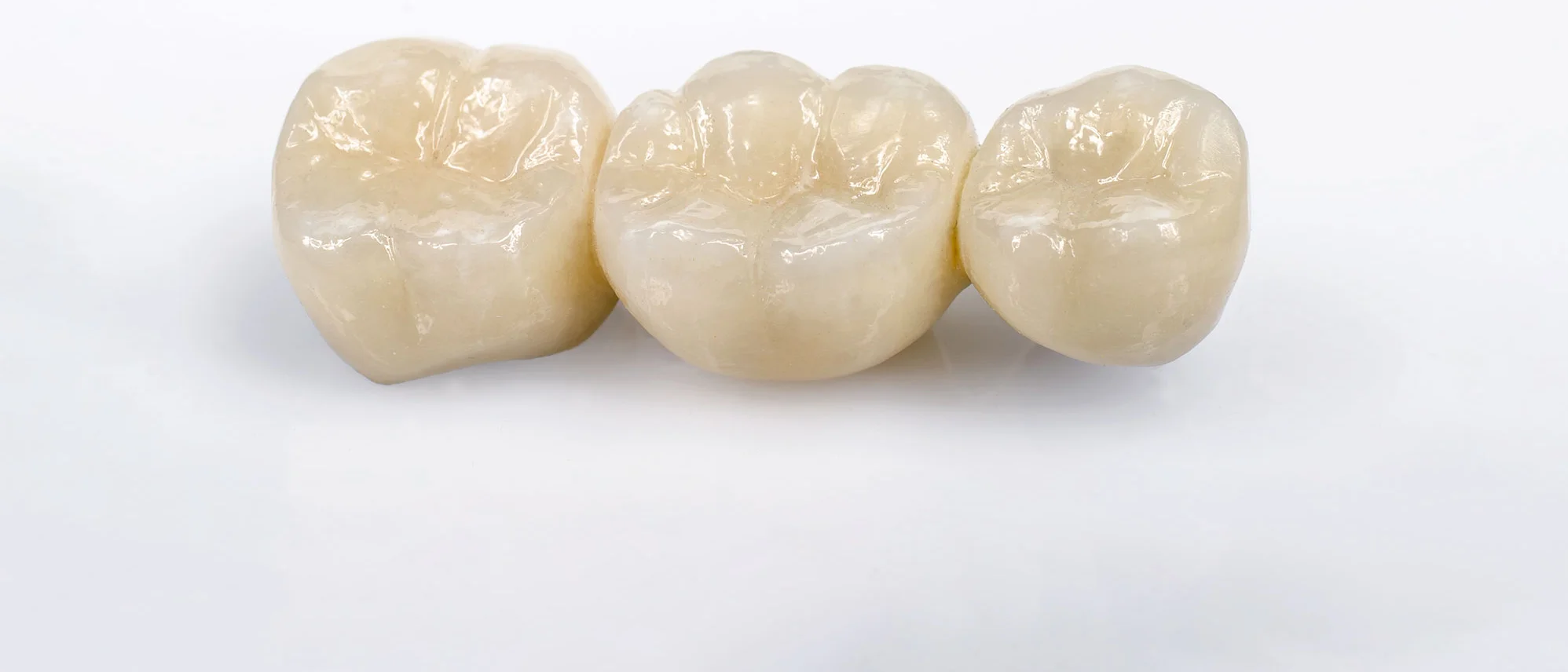
High-quality dentures in Regensburg
For a stable and firm grip

Dentures are divided into different classes: Fixed dentures include crowns, partial crowns and bridges, and removable dentures are divided into complete dentures and partial dentures Combined dentures consist of a fixed cemented part and a removable part. Dentures are intended to restore the chewing performance of partially or edentulous jaws; other aspects concern esthetics and speech performance.
We replace missing or damaged teeth with high-quality dentures – from crowns and bridges to removable prostheses and implant-supported solutions. The goal is always to restore chewing ability, aesthetics and speech function.



Fixed dentures are attached to existing teeth, which then also bear the chewing forces of the teeth to be replaced. The rule of thumb here is that each tooth can absorb the chewing pressure of another tooth. Therefore, for every two teeth to be replaced, at least two abutment teeth should be available. Fixed dentures come closest to the natural situation and are therefore - unlike removable dentures - able to almost completely restore the normal chewing and speaking function.
The following types of fixed dentures are available:
Bridges consist of bridge abutments (fixing elements) and pontics. Bridges can be made of zirconium, ceramic or a combination of both materials and are permanently fixed to the appropriately prepared abutment teeth with a special cement.
A telescopic bridge is a bridge whose abutments are telescopic crowns (double crowns). Their wearing comfort corresponds to fixed dentures, as this construction is supported by the abutment teeth and the oral mucosa has no supporting function. This type of denture is removable and should be maintained regularly.
Individual dental crowns are not dental prostheses in the true sense of the word, but serve to preserve the teeth. In Germany, every dental crown is classified as a dental prosthesis for billing purposes, which leads to a financial contribution on the part of the patient. A dental crown completely covers the tooth in question. Partial crowns do not completely cover the tooth in question and are therefore often referred to as 3/4 crowns.
An implant is a tooth root replacement to which a crown or denture is attached. The function of implants is almost the same as that of natural teeth. They can be used as a single tooth replacement or as a holding and supporting element in combined dentures. An implant can be indicated if a single tooth is missing, the neighbouring teeth are healthy and these should not be prepared, i.e. ground down, to accommodate a bridge. The dental implant is then crowned with a single crown.
A veneer is a thin, translucent ceramic shell for the teeth, which is bonded to the tooth surface with a special adhesive. Veneers find their mainly.
Removable dentures are anything that is not firmly attached to teeth or anchored in the jaw, including complete and partial dentures as well as telescopic dentures. The still very common partial and complete dentures with metal clasps and palatal rests often impair patients' quality of life. While dentures in the upper jaw adhere well due to the relatively large contact surface of the palatal plate, the hold of a denture in the lower jaw is often impaired.
Clear disadvantages of removable dentures are limited chewing function, problems with speaking and, of course, the less appealing aesthetics. Poorly fitting dentures often cause pressure points and pain. Another serious disadvantage is that the jawbone is not naturally stressed by chewing. This can cause the jawbone to slowly recede, which in turn reduces denture retention.
The advantage of conventional removable partial and full dentures is clearly relatively low cost. In addition, it is possible to quickly extend the denture, if necessary, when the dental status has changed and more teeth need to be replaced.
As if they were your own! Implants are artificial tooth roots that are inserted into the jawbone and firmly fuse with it. As a fixed and fully loadable dental prosthesis, the implant is a high-quality alternative and supplement to a bridge or a conventional denture. In fact, they are suitable for stabilizing dentures in the edentulous jaw.
The many advantages: natural aesthetics, high wearing comfort, chewing comfort as well as the safety and long service life speak for a restoration with implant-anchored dentures. They also avoid grinding the neighboring teeth, as would be necessary with a bridge restoration. Only the lost tooth is replaced. At the same time, further bone loss is prevented by loading the bone (by transmitting the chewing forces).
We distinguish between fixed dentures (e.g. crowns, partial crowns, bridges), removable dentures (full and partial dentures) and combined dentures, which consist of a fixed and a removable part. In addition, implants can be used as artificial tooth roots.
Fixed dentures are permanently attached to existing teeth. These abutment teeth then also bear the chewing load of the replaced teeth. This is the closest to the natural situation and can almost completely restore chewing and speaking functions.
Bridges close one or more gaps between teeth by attaching them to adjacent abutment teeth. They consist of bridge abutments and bridge elements and can be made of zirconium or ceramic, for example.
With combined dentures, one part is firmly anchored in the mouth (e.g. telescopic bridge with double crowns) and one part is removable. This ensures good wearing comfort and, at the same time, good cleanability.
These include full and partial dentures as well as telescopic dentures. They are not permanently anchored in the mouth. The advantages are the comparatively low cost and the possibility of extending them later. Disadvantages include limited chewing function, possible denture retention and the often less aesthetic effect.
In the upper jaw, the palate plate still provides a certain amount of adhesion. In the lower jaw, it is often more difficult to achieve a secure fit. In addition, removable dentures do not place natural pressure on the jawbone, which can lead to bone loss and further impair the fit.
An implant is an artificial tooth root replacement onto which a crown or other dental prosthesis is attached. It is useful, for example, when a single tooth is missing and the healthy neighbouring teeth should not be ground down for a bridge, or when a prosthesis needs to be stabilised.