
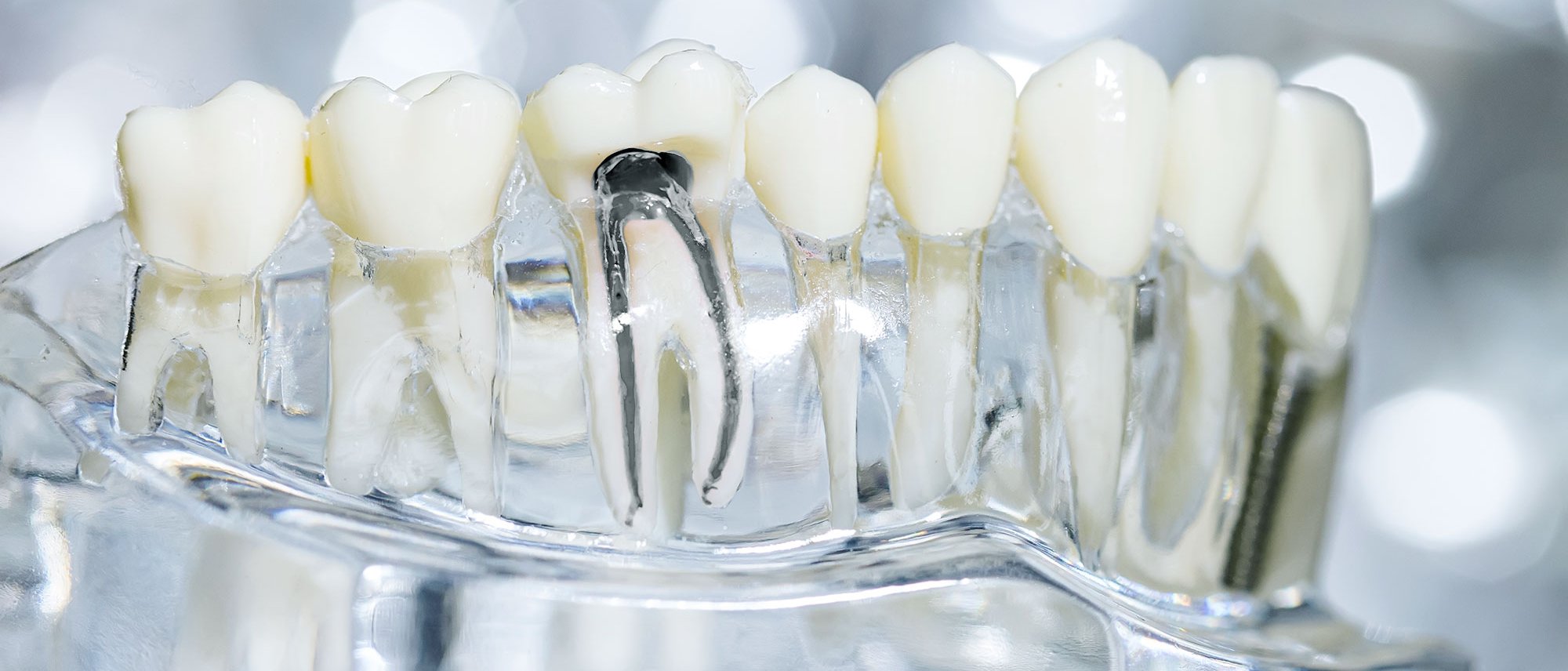
Tooth preservation in Regensburg
Modern endodontics for long-term tooth preservation.

Endodontics or root canal treatment deals with the inflammation of nerve tissue. Often undetected, caries can spread under a filling or crown and lead to infection of the tooth root.
If the tooth nerve is inflamed, we clean the canal system using modern, mechanical technology, determine the exact length electronically and seal the tooth tightly – so that your own tooth is preserved.






During root canal treatment, it is important to be extremely thorough and careful so that all bacteria that have invaded the tooth nerve and the inflamed tissue can be removed. Afterwards, the fine root canals are closed again cleanly and tightly. Using modern technology, even fine or highly curved root canals are carefully and gently prepared by machine. A permanent real-time length/position control of the file in the canal is also possible.
Thanks to the mechanical canal preparation, the treatment process is gentler and faster than with the manual technique and is generally more pleasant for the patient. This enables a more thorough cleaning and a more precise filling of the canals, so that you can keep your own tooth for a long time.
Electrometric length determination
Electrometric length determination (endometry) refers to the measurement of the root canal length of a tooth using an electronic measuring device. The measurement is based on the fact that there is a constant electrical resistance between the root membrane and the mucosa, which drops abruptly when the root tip is reached. Alongside radiographic length determination, endometric measurement is currently the most accurate method for determining the exact length of the root canal.
Thermafil method
After the root canals have been completely prepared up to the root tip and rinsed with disinfecting solutions, the length of the individual canals is again determined using endometry.
The next step is the definitive filling of the root canals. For this purpose, a post made of gutta-percha, which has been heated beforehand, is inserted into each canal in turn. The heating allows the post to expand in the root canal and fill the entire volume of the canal. In this way, we can prevent air pockets or areas without filling.
Once this step is complete, we take a control X-ray to assess whether all the root canals have been optimally filled. If this is the case, the crown of the tooth also receives a filling and is sealed tightly.
Denture planning
Once the root canal treatment is completed and the tooth is tightly sealed, it is a case of waiting. After about 3 months, we check the tooth again and assess whether the tooth in question is symptom-free and whether it has calmed down. In an X-ray of the tooth, we see whether the inflammation around the root tip has also subsided.
If this is the case and the root canal treatment was thus successful, it is time to plan a tooth replacement in the form of a single-tooth crown or, depending on the individual situation, another type of tooth replacement.
Since teeth after root canal treatment no longer have the nourishing blood vessels running through them together with the nerve, we have to give the tooth stability again by means of a crown. This crown is additionally anchored in the tooth with a glass fibre pin so that the bond between the tooth and the denture is optimal.
If the tooth nerve has become inflamed due to deep caries, a leak under a filling or crown, or an infection, the bacteria and inflamed tissue must be removed from the tooth. Root canal treatment makes it possible to preserve your own tooth.
With modern, mechanical technology, even very fine or severely curved root canals can be carefully and gently treated. The procedure is often more comfortable for patients and allows for more thorough cleaning and more precise filling.
For inspection purposes. We use this to check whether all root canals are filled to the tip and whether the filling is tight. Only then is the tooth crown closed again.
After about three months, we check whether the tooth is symptom-free and whether the inflammation in the area of the root tip has subsided. Once everything has healed, we plan the final dental prosthesis.
A tooth that has undergone root canal treatment is no longer supplied with blood vessels and is therefore more susceptible to fracture. To stabilise it in the long term, it is crowned. Often, a glass fibre post is also inserted to strengthen the bond between the tooth and the crown.
As a rule, root canal treatment is usually painless thanks to the anaesthesia of the tooth and modern electrometric mechanical preparation of the root canal.
If the tooth is thoroughly prepared, tightly filled, checked and then fitted with a suitable crown, it can often remain in the mouth for many years – and that is precisely the goal of endodontic treatment at our practice in Regensburg.