
Dental implants in Regensburg
Fixed dentures for lost teeth

Dental implants are effective replacements for lost teeth. Whether as a single tooth, bridge anchor or anchorage for removable dentures with the help of implants we effectively restore chewing function and aesthetics. Periodontal surgery provides relief in cases of severe periodontitis.
We replace missing teeth with implants, create bone through augmentation where necessary, and treat advanced periodontitis surgically – for stable function and aesthetics.





Clarification, preliminary examination, consultation and procedure
Before we place one or more implants, we will have a detailed discussion with you about the possibilities and risks of the treatment. We will also ask you about your wishes and take them into account in the planned treatment.
In the preliminary examination we clarify whether you have inflammations, enough bone for placing the implants and whether you are in good health for the surgical procedure. Only then is a smooth procedure guaranteed. If there is inflammation in the jaw, it must be treated beforehand. If there is not enough bone, bone augmentation can be performed depending on the individual situation.
On the basis of the preliminary examination, we will show you the options, which prosthetic restoration is suitable for you and how many implants you need. One implant is sufficient for individual teeth, but several implants are necessary for a prosthesis.
Based on this planning, a treatment and cost plan will be drawn up to give you an overview of the costs for the implants. The statutory health insurance companies do not cover the costs of treatment with dental implants, only the dentures worn are subsidised. You will receive the fixed allowance for the corresponding standard dental prosthesis.
Implant placement is usually done under local anaesthetic. As soon as the anaesthetic takes effect and your jaw is insensitive to pain, we start the dental implant surgery.
The wound over the implants is then sutured tightly so that the dental implants can heal well into the bone.
Once the artificial tooth root has been placed, the patient should take it easy and avoid physical exertion. Good oral hygiene and disinfecting rinses are recommended. Until the new teeth are fitted, we regularly check the healing of the wound. Once this is complete and the implant is well anchored in the bone, the implants are uncovered and the denture is inserted after taking an impression. This concludes the treatment.
Augmentation
If the amount of bone is not sufficient or the jawbone structure is not right to anchor a dental implant firmly in the jaw, bone augmentation becomes necessary. Bone loss or bone resorption is the result of toothlessness or dental disease and continues to progress independently without adequate treatment. Without treatment, the remaining dentition is also at risk of severe consequences for dental health and further tooth loss.
If conventional periodontal treatment is no longer sufficient to eliminate periodontitis, a so-called periodontal surgery may be necessary to preserve the teeth in the long term. This involves opening the gum pockets and cleaning the tooth roots, also using minimally invasive methods such as ultrasound. Thanks to the latest surgical methods, such oral surgery procedures can be performed very gently today.
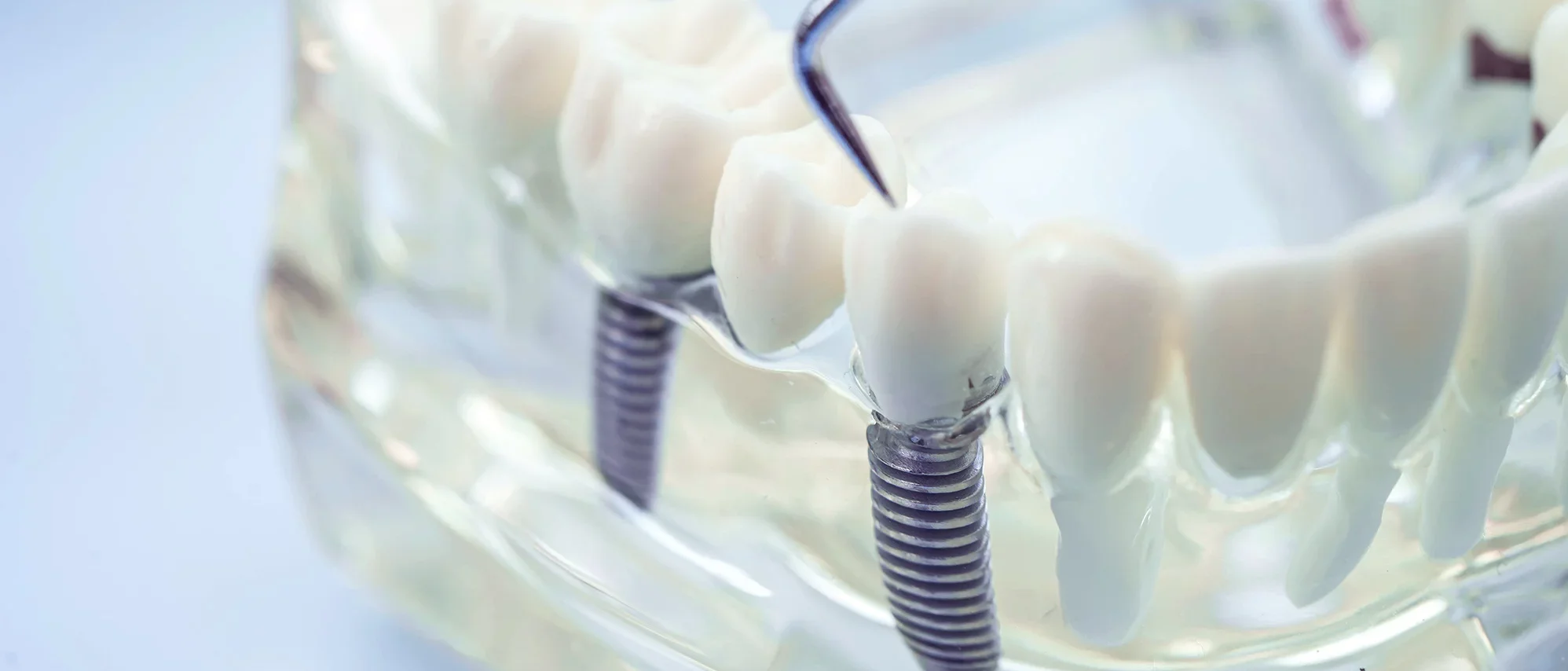
A dental implant is an artificial tooth root that is anchored in the jaw. A crown, bridge or even a prosthesis can then be attached to it. This is how we restore chewing function and aesthetics after tooth loss at our dental practice in Regensburg.
First, we will have a detailed consultation. During the preliminary examination, we will check for inflammation, assess the condition of your bones and determine your overall suitability. We will then plan the number and type of implants and draw up a treatment and cost plan. The implantation itself is usually performed under local anaesthetic, followed by a healing phase and later the fitting of dentures.
Statutory health insurance funds do not cover the actual costs of implants. Only the dentures placed on top of them are subsidised as part of standard care. You can see the expected personal contribution in the treatment and cost plan.
Because we can only achieve stable results if there is no inflammation, sufficient bone is available and the patient is suitable for the procedure. If, for example, there is inflammation in the jaw, this must be treated first.
The implantation is usually performed under local anaesthetic. Once the jaw is numb, we begin the procedure. After the operation, the patient should take it easy, maintain good oral hygiene and attend follow-up appointments.
The implant must first heal firmly into the bone. During this time, we regularly check the wound healing. Only when the implant is stable is it exposed, an impression taken and the final denture inserted.
Physical exertion should be avoided immediately after implantation. Good oral hygiene and disinfectant rinses support healing. The practice in Regensburg checks the healing process at regular intervals.
For patients who want fixed dentures after tooth loss – functional and aesthetic – and whose bone situation (possibly after augmentation) and general health allow the procedure.